
The Ultimate Guide to Calculating Your IVF Due Date: Accuracy, Milestones, and What to Expect
The journey of In Vitro Fertilization (IVF) is filled with precise timing, medical protocols, and emotional milestones. After the egg retrieval and the anxious wait for the embryo transfer, one burning question dominates every patient's mind: "When is my baby actually due?"
Unlike natural conception, where doctors estimate based on your Last Menstrual Period (LMP), IVF offers a unique advantage: precision. Because you know the exact moment of fertilization (or transfer), your due date can be calculated with significantly higher accuracy.
This guide explores the science behind IVF due dates, how to calculate them correctly for Day 3 and Day 5 transfers, and the critical milestones you can expect along the way.
Why Standard Pregnancy Calculators Get It Wrong
If you search for a generic "pregnancy calculator" online, it will almost always ask for the first day of your last period. For natural pregnancies, this works reasonably well because ovulation usually happens around day 14 of a 28-day cycle.
However, in an IVF cycle, your body's natural timeline is often manipulated by medications.
- You might have had weeks of suppression (birth control) before stimulation.
- Your "ovulation" is effectively your Egg Retrieval Date, which is medically timed.
- Using a standard LMP calculator can throw your due date off by several days or even a week, leading to unnecessary anxiety about fetal growth measurements later on.
To get the correct date, you must calculate based on the Embryo Transfer Date and the Embryo Age (Day 3 or Day 5).
The Math: How to Calculate Your Due Date
The standard human gestation period is 280 days (40 weeks) from the LMP, or 266 days (38 weeks) from conception. In IVF, the "conception" clock starts ticking at fertilization (Egg Retrieval).
Here is the manual breakdown of how the specialized algorithms work on IVF Due Date Calculator:
1. For Day 5 Embryo Transfers (Blastocysts)
Day 5 transfers are the most common in modern IVF clinics. Since the embryo was already 5 days old when it entered your uterus, you are technically "5 days pregnant" (in terms of fetal age) at the moment of transfer.
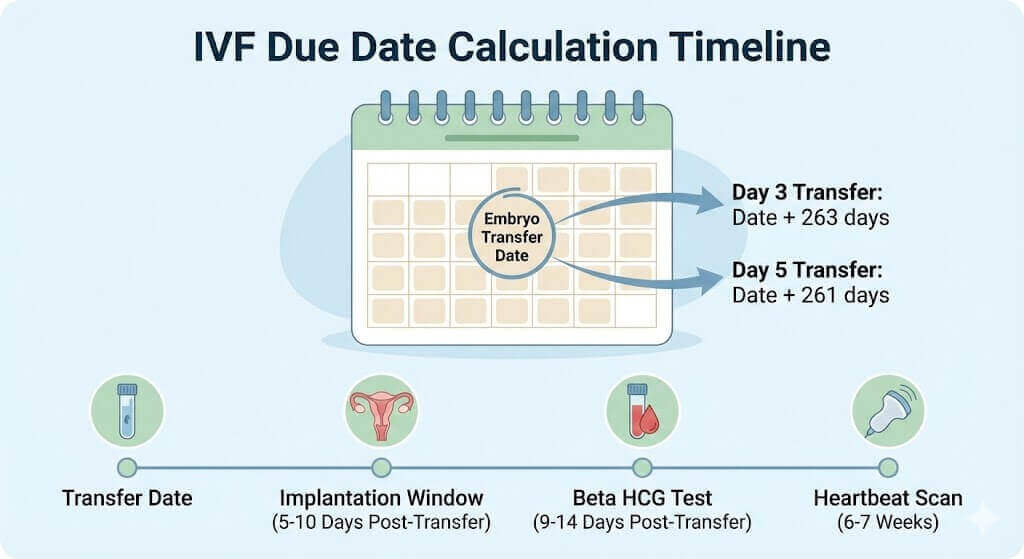
- The Formula: Transfer Date + 261 Days = Estimated Due Date (EDD)
- Why 261? Standard gestation (266 days from conception) minus the 5 days of age the embryo already has.
2. For Day 3 Embryo Transfers (Cleavage Stage)
Some embryos are transferred earlier, at the cleavage stage.
- The Formula: Transfer Date + 263 Days = Estimated Due Date (EDD)
- Why 263? Standard gestation (266 days) minus the 3 days of age the embryo has.
Step-by-Step: Using an IVF-Specific Calculator
While the math above is helpful, manually counting 261 days on a calendar is prone to error. It is highly recommended to use a dedicated tool.
- Identify your Transfer Date: Check your clinic discharge paperwork.
- Confirm Embryo Type: Was it a Day 3 or Day 5 embryo? (Ask your embryologist if unsure).
- Input Data: Go to a specialized tool like the IVF Due Date Calculator and enter your specific dates.
- Get Your Timeline: The tool will provide your estimated due date and, often, a timeline of when to expect specific testing milestones.
Your IVF Pregnancy Timeline: Key Milestones
Once you have your accurate due date, you can map out the critical checkpoints of your first trimester. This period is often called the "Two Week Wait" (TWW) and beyond.
Days 1-9 Post Transfer (The Implantation Window)
In the days following your transfer, the embryo must hatch and implant into the uterine lining. You likely won't feel anything distinct, though "phantom symptoms" from progesterone support (bloating, breast tenderness) are common.
- Action: Continue your medications exactly as prescribed. Avoid home pregnancy tests if possible, as trigger shots can give false positives.
Day 9-14 Post Transfer (The Beta HCG)
This is "Judgment Day" for many. Your clinic will run a blood test (Beta) to measure HCG levels.
- What to look for: Doctors generally look for a number above 50 or 100 mIU/mL, but the doubling time (every 48 hours) is more important than the starting number.
Week 6-7 (The Heartbeat Scan)
Based on your calculated IVF due date, your clinic will schedule an early ultrasound, usually around week 6.5 or 7.
- Goal: To visualize the gestational sac, yolk sac, and fetal pole, and to detect a heartbeat.
- Reality Check: If you measure a few days behind or ahead, don't panic. Even with precise IVF dating, measurements can vary by ±3 days due to the tiny size of the embryo and the angle of the ultrasound wand.
FAQ: IVF Dates vs. Ultrasound Dates
Q: My doctor changed my due date after the ultrasound. Which one is right?
A: In natural pregnancy, the ultrasound date is considered the "gold standard" because ovulation dates are estimated. However, in IVF, your transfer date is a biological fact. Most IVF doctors will stick to the due date derived from your transfer date unless the ultrasound shows a discrepancy of more than 5-7 days, which might indicate a growth issue.
Q: Does a frozen transfer change the due date calculation?
A: No. The time the embryo spent frozen (cryopreservation) pauses its biological clock. The calculation resumes solely based on the day it was thawed and transferred.
Conclusion
Precision brings peace of mind. In a process as uncertain as infertility treatment, knowing your exact due date helps you reclaim a sense of control. It allows you to track your baby's development week-by-week with accuracy that natural conception rarely affords.
Whether you are just preparing for your transfer or have just received your first positive Beta, take a moment to celebrate. You have navigated the science; now it is time to trust the process.
References
- American Society for Reproductive Medicine (ASRM) - "Defining the Due Date in ART Pregnancies"
- PubMed Central - "Validation of gestational age determination from ultrasound vs. IVF transfer dates"