
Beyond the Calculator: The Real Timeline of Your IVF Pregnancy (Week by Week)
You’ve done the math. You’ve likely visited our IVF Due Date Calculator five different times today just to see those dates in writing.
But if you are like most IVF warriors, the math is confusing. Why does your doctor say you are "4 weeks pregnant" when your transfer was only two weeks ago? Why doesn't the Last Menstrual Period (LMP) method work for you? And most importantly, does a specific due date actually guarantee when the baby arrives?
Let’s cut through the noise. This isn't just about dates on a calendar; it’s about understanding the unique biology of your IVF pregnancy, managing the anxiety of the "wait," and knowing exactly what is happening inside your body, week by precious week.
The "Fake" Two Weeks: Why IVF Math is Different
If you try to use a standard pregnancy wheel used by OB-GYNs for natural conceptions, your dates will likely be wrong. Here is why.
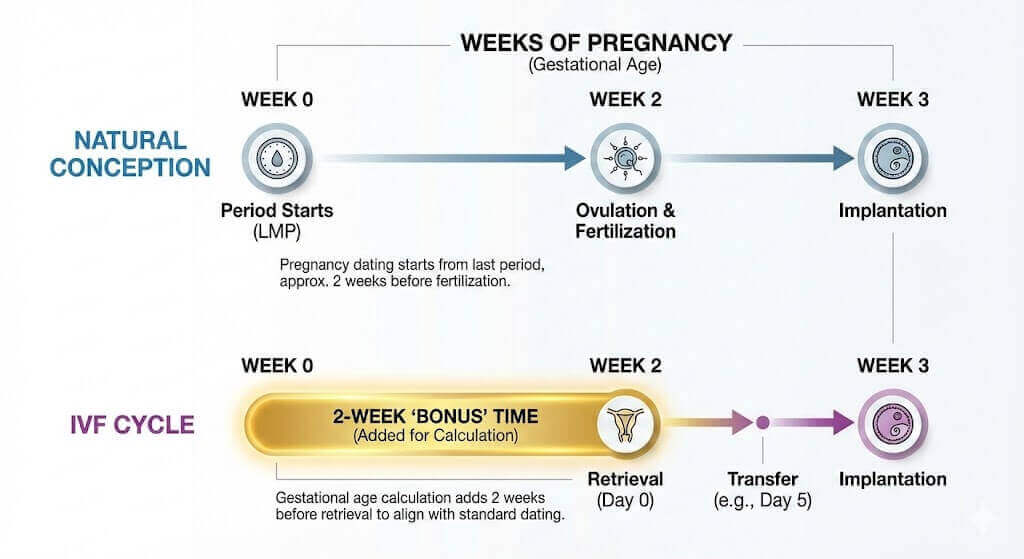
In a "natural" pregnancy, the clock starts ticking on the first day of your last period. But biology is imperfect. Ovulation can happen on day 11, day 14, or day 20.
In IVF, we know the exact moment of conception. Science has removed the guesswork.
The "266 Days" Rule
Standard human gestation is roughly 266 days from conception (fertilization).
- Natural Conception: We guess conception happened ~14 days after your period starts.
- IVF: We don't guess. We take your Transfer Date and add the age of the embryo (Day 3 or Day 5).
The Implantation Window: What’s Actually Happening?
After you walk out of the clinic on Transfer Day, the real work begins. But it’s not instantaneous. Just because the embryo is inside, doesn’t mean you are "pregnant" yet. It needs to stick.
Here is the microscopic timeline that generic apps won't tell you:
Day 0 to Day 2 Post-Transfer (The Hatching)
If you transferred a Day 5 blastocyst, the embryo is currently breaking out of its shell (the zona pellucida). If you did Assisted Hatching, this head-start helps.
- What you feel: Likely nothing. Maybe mild cramping from the catheter.
- The Trap: Don't analyze every twinge. Progesterone supplements (suppositories or PIO shots) mimic pregnancy symptoms perfectly. Sore boobs? Progesterone. Bloating? Progesterone.
Day 3 to Day 5 Post-Transfer (The Connection)
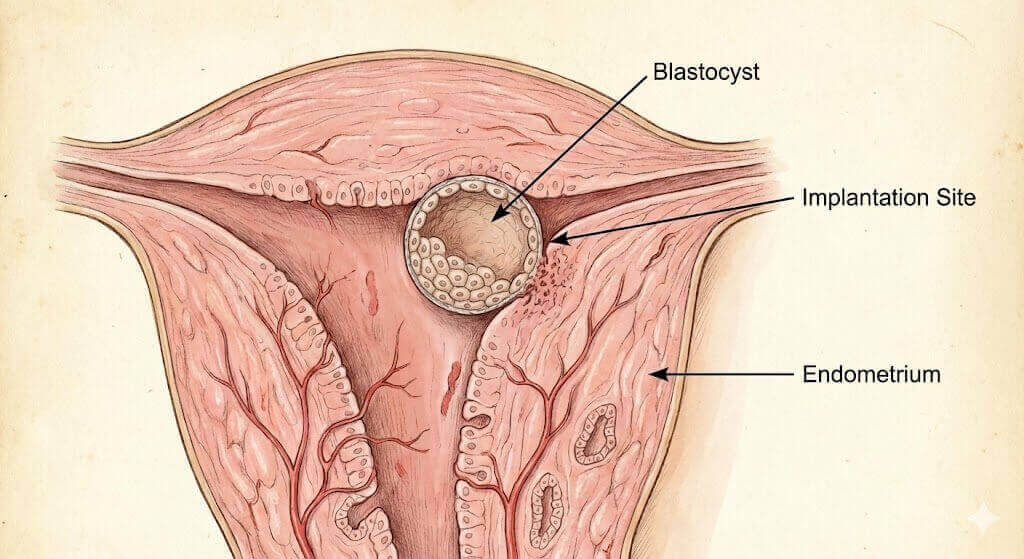
The blastocyst makes contact with the uterine lining and begins to bury itself deep within the endometrium. This is implantation.
- Spotting Alert: Some women experience "implantation bleeding" (light pink/brown spotting). If you see this, don't panic. It is often a good sign. Conversely, if you don't see it, don't panic either. Only about 30% of women experience visible implantation bleeding.
The "Beta" Hell: HCG Levels and Doubling Times
Fast forward to "Beta Day" (usually 9–14 days post-transfer). This is your first official blood test.
Many people think a high number is the goal. It’s not. The goal is the doubling time.
- Scenario A: Initial hCG is 300. Two days later, it's 350. (This is concerning).
- Scenario B: Initial hCG is 80. Two days later, it's 180. (This is fantastic).
A study published in Fertility and Sterility suggests that for Day 5 transfers, an hCG level >100 mIU/mL on day 10 post-transfer is a strong predictor of a live birth. However, healthy babies have been born with starting betas of 40.
Practical Advice: Stop peeing on sticks after your positive blood test. Home pregnancy tests cannot measure quantity, only presence. They will not tell you if your numbers are doubling, but they will spike your anxiety if the line looks 1% lighter than yesterday.
The 6-Week Viability Scan: The Real Milestone
Your due date calculator says you are 6 weeks pregnant. This is usually when the first ultrasound happens.
What we are looking for:
- Gestational Sac: Is it in the uterus? (Ruling out ectopic pregnancy).
- Yolk Sac: This nourishes the embryo before the placenta takes over.
- Fetal Pole & Heartbeat: By 6 weeks and 5 days, we usually hope to see a flicker.
Case Study: The "Empty Sac" Scare
Let's talk about Maya. Maya went in for her scan at exactly 6 weeks, 0 days based on her transfer date. The doctor saw a sac, but no heartbeat. Maya was devastated.
The Reality: 6 weeks is the earliest threshold. Sometimes, implantation happened a day late. Maya went back at 6 weeks, 5 days, and there was a heartbeat of 120 bpm.
The Lesson: Early scans are notorious for causing anxiety. If you measure 2–3 days "behind," it is often within the margin of error for ultrasound measurements (which are measured in millimeters!).

Why Your Due Date Might Change (But Probably Shouldn't)
Here is a point of confusion for many IVF patients. You go to your regular OB-GYN (who might not be an IVF specialist), they measure the baby, and say: "Oh, you're measuring 5 days ahead! Let's move your due date up."
Do not let them do this.
In IVF, your dating is precise. Babies grow at different rates. Just because your baby is tall (measuring ahead) doesn't mean they are physiologically older.
Rule of Thumb: Stick to your IVF-calculated due date for the entire pregnancy unless the discrepancy is massive (over 7–10 days). Accurate dating is crucial for determining things like induction dates later on.
Summary Checklist: Your Next Steps
You have your date from our calculator. Here is your roadmap:
- Trust the Date: Use the IVF Due Date Calculator to set your baseline.
- The 48-Hour Rule: During the beta phase, focus on the 48-hour doubling, not the single number.
- Hydrate: Progesterone dehydrates you. Drink 2–3 liters of water a day to help with bloating and absorption.
- Graduation: You typically "graduate" from your fertility clinic to a regular OB-GYN around week 8–10. Make sure you have those records ready.
This journey is a marathon, not a sprint. Your due date is the finish line, but every single week you check off is a victory.
References & Further Reading
- American Society for Reproductive Medicine (ASRM) – Defining the Gestational Age in IVF.
- Fertility and Sterility Journal – hCG trends and pregnancy outcomes.
- National Institutes of Health (NIH) – Ultrasound milestones in early pregnancy.
(Disclaimer: This article is for educational purposes only and does not constitute medical advice. Always consult your fertility specialist for your specific medical needs.)