
Understanding IVF: A Complete Guide to In Vitro Fertilization
In vitro fertilization (IVF) has revolutionized reproductive medicine, offering hope to millions of couples struggling with infertility. This comprehensive guide provides everything you need to know about IVF, from the basic science to the complete process, helping you make informed decisions about your fertility journey.
What is IVF?
In vitro fertilization (IVF) is an assisted reproductive technology (ART) procedure where eggs are retrieved from a woman's ovaries, fertilized with sperm in a laboratory setting, and then transferred back into the uterus. The term "in vitro" means "in glass," referring to the laboratory environment where fertilization occurs outside the body.
Who Can Benefit from IVF?
IVF can help individuals and couples facing various fertility challenges:
- Blocked or damaged fallopian tubes: IVF bypasses the fallopian tubes entirely
- Male factor infertility: Low sperm count, poor motility, or abnormal morphology
- Ovulation disorders: Irregular or absent ovulation
- Endometriosis: When endometrial tissue affects fertility
- Unexplained infertility: When no specific cause is identified
- Age-related fertility decline: For women over 35
- Genetic disorders: When preimplantation genetic testing is needed
- Same-sex couples: Using donor gametes
The Complete IVF Process: Step by Step
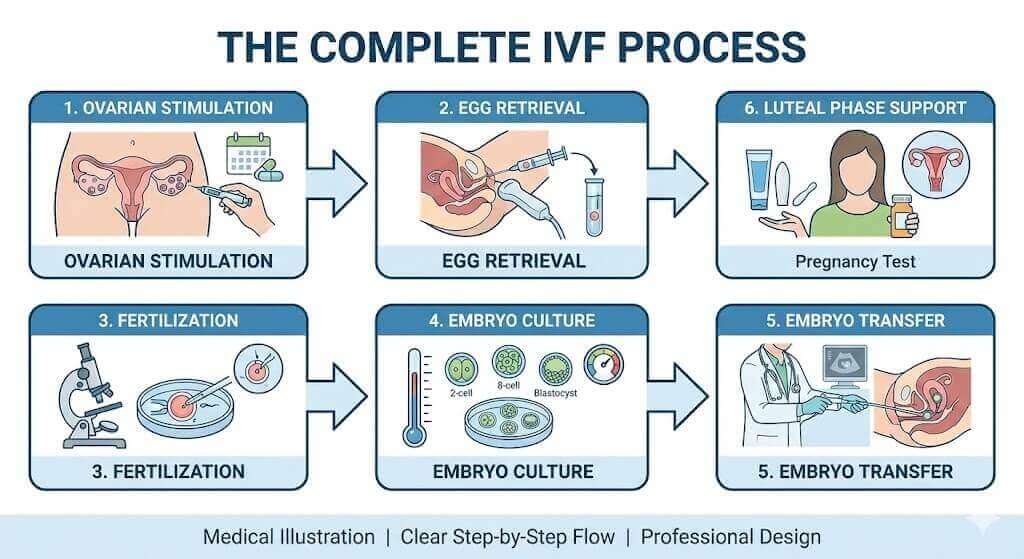
Step 1: Ovarian Stimulation
The IVF process begins with ovarian stimulation using fertility medications:
- Follicle-stimulating hormone (FSH): Stimulates multiple egg development
- Luteinizing hormone (LH): Triggers final egg maturation
- Gonadotropin-releasing hormone (GnRH): Controls the timing of ovulation
During this phase (typically 8-14 days), you'll have regular monitoring through:
- Blood tests to measure hormone levels
- Ultrasound scans to track follicle development
- Medication adjustments based on your response
Step 2: Egg Retrieval
Once follicles are mature, eggs are retrieved through a minor surgical procedure:
- Timing: Usually 34-36 hours after the final trigger shot
- Procedure: Performed under sedation, using ultrasound-guided needle aspiration
- Duration: Typically 15-30 minutes
- Recovery: Brief observation period, then rest at home
Step 3: Fertilization
In the laboratory, eggs are fertilized with sperm:
- Conventional IVF: Eggs and sperm are placed together in a culture dish
- Intracytoplasmic Sperm Injection (ICSI): A single sperm is injected directly into each egg
- ICSI is used when: Sperm quality is poor, previous IVF failed, or using frozen sperm
Step 4: Embryo Culture
Fertilized eggs (now embryos) are cultured in a laboratory incubator:
- Day 1: Check for fertilization (two pronuclei visible)
- Day 2-3: Cleavage stage - cells divide (6-8 cells typical)
- Day 5-6: Blastocyst stage - 100+ cells with differentiated structures
Step 5: Embryo Transfer
Selected embryos are transferred into the uterus:
- Timing: Day 3 (cleavage) or Day 5 (blastocyst) after fertilization
- Procedure: Simple, painless procedure using a thin catheter
- Number: Typically 1-2 embryos, depending on age and embryo quality
- After transfer: Rest briefly, then resume normal activities
Step 6: Luteal Phase Support
After transfer, you'll take medications to support implantation:
- Progesterone supplements (oral, vaginal, or injection)
- Estrogen supplements if needed
- Continue until pregnancy test (about 10-14 days after transfer)
Understanding Embryo Stages
Day 3 Embryos (Cleavage Stage)
- Cell Count: 6-8 cells
- Development: Rapid cell division
- Advantages: Less time in lab, natural selection
- Transfer Timing: 3 days after fertilization
Day 5 Embryos (Blastocyst Stage)
- Cell Count: 100+ cells
- Development: Differentiated into inner cell mass and trophectoderm
- Advantages: Better selection, higher success rates
- Transfer Timing: 5 days after fertilization
Success Rates and Factors
IVF success rates vary based on several factors:
- Age: Highest success rates for women under 35
- Embryo Quality: Higher quality embryos have better outcomes
- Previous Pregnancies: History of successful pregnancy improves chances
- Cause of Infertility: Some conditions respond better than others
- Lifestyle Factors: Weight, smoking, alcohol use affect outcomes
Costs and Insurance
IVF costs vary significantly:
- Average Cost: $12,000-$15,000 per cycle in the United States
- Additional Costs: Medications ($3,000-$5,000), genetic testing, storage
- Insurance Coverage: Varies by state and plan
- Financial Assistance: Some clinics offer payment plans or grants
Risks and Considerations
Physical Risks
- Ovarian Hyperstimulation Syndrome (OHSS): Rare but serious complication
- Multiple Pregnancy: Higher risk of twins or triplets
- Ectopic Pregnancy: Slightly increased risk
- Procedure Risks: Minimal risks from egg retrieval
Emotional Considerations
- Stress and anxiety during the process
- Disappointment if cycles are unsuccessful
- Financial strain
- Relationship challenges
Preparing for IVF
Before starting IVF, consider:
- Medical Evaluation: Complete fertility workup
- Lifestyle Changes: Healthy diet, exercise, stress management
- Financial Planning: Understand costs and insurance coverage
- Support System: Family, friends, or support groups
- Clinic Selection: Research success rates and patient reviews
What to Expect During IVF
Timeline
- Initial Consultation: 1-2 weeks
- Pre-cycle Preparation: 2-4 weeks
- Stimulation Phase: 8-14 days
- Egg Retrieval: 1 day
- Embryo Culture: 3-6 days
- Transfer and Wait: 10-14 days
- Total Cycle: Approximately 4-6 weeks
After IVF: Pregnancy and Beyond
If IVF is successful:
- Early Pregnancy: Similar to natural conception, with some differences
- Prenatal Care: Standard care with additional monitoring
- Due Date Calculation: More accurate than natural conception (see our complete guide)
- Risks: Slightly higher risk of certain complications
Conclusion
IVF is a complex but highly effective fertility treatment that has helped millions of people achieve their dream of parenthood. Understanding the process, what to expect, and how to prepare can help you navigate your IVF journey with confidence. Remember, every journey is unique, and success rates continue to improve with advancing technology and techniques.
For more information, explore our guides on IVF due date calculation, IVF pregnancy, and embryo stages.